SACCUSA President Neil Diamond urges the South African government to act now to protect US market access, as a key notification deadline for 2027 AGOA eligibility approaches.
ATLANTA, GEORGIA — The South African Chamber of Commerce in the USA (SACCUSA) today warned that South Africa faces a real risk of losing its preferential trade benefits under the African Growth and Opportunity Act (AGOA), even though Congress has just extended the program to December 2028.
SACCUSA President Neil Diamond called on the South African government to treat the protection of AGOA eligibility, and the wider US–South Africa trade relationship, as an immediate national economic priority.
South Africa exported roughly $16.5 billion in goods to the United States in 2025. Losing AGOA status would reach well beyond tariff preferences, putting long-standing commercial relationships, manufacturing investment, agricultural exports and jobs at risk.
“This is a $16 billion question, and it needs an urgent answer from our government. Will Washington cut South Africa out of AGOA before Christmas, or can we show that keeping and growing this trading relationship serves the economic interests of both countries?
South Africa cannot afford complacency. Government must engage Washington now, with a credible, commercially grounded strategy that speaks to American trade priorities and protects our access to the US market.”
– Neil Diamond, President, SACCUSA
The deadline that matters: on or about 2 November
On 2 September 2026, President Donald Trump signed legislation extending AGOA to 31 December 2028, following broad bipartisan support in Congress for continued preferential trade with eligible African countries.
The extension keeps the program alive, but it does not guarantee any individual country a place in it. Eligibility is reviewed every year, and the US administration retains the authority to withdraw a country’s benefits.
Under the AGOA statute, the President must notify Congress and the affected country at least 60 days before a country’s designation is terminated. For a termination to take effect at the start of the next annual cycle on 1 January 2027, that notice would therefore have to be given by approximately 2 November 2026. A later notice would not stop a termination, but would push its earliest effective date beyond 1 January.
As of 26 October, South Africa remains an AGOA-eligible country. With the notification window closing within days, exporters, investors and businesses trading between the two countries face significant uncertainty.
“Hope is not a trade strategy. South Africa must prepare for the possibility of exclusion, but our first priority must be to prevent it. That takes urgent, high-level engagement, clear commitments and a practical understanding of what Washington expects from its trading partners.”
– Neil Diamond
A relationship worth protecting
According to the Office of the United States Trade Representative, two-way trade in goods and services between South Africa and the United States reached approximately $28.8 billion in 2025, up 10.1% on the previous year.
South African goods exports to the US totaled about $16.5 billion, US goods exports to South Africa about $6.3 billion, and services trade in both directions about $6 billion.
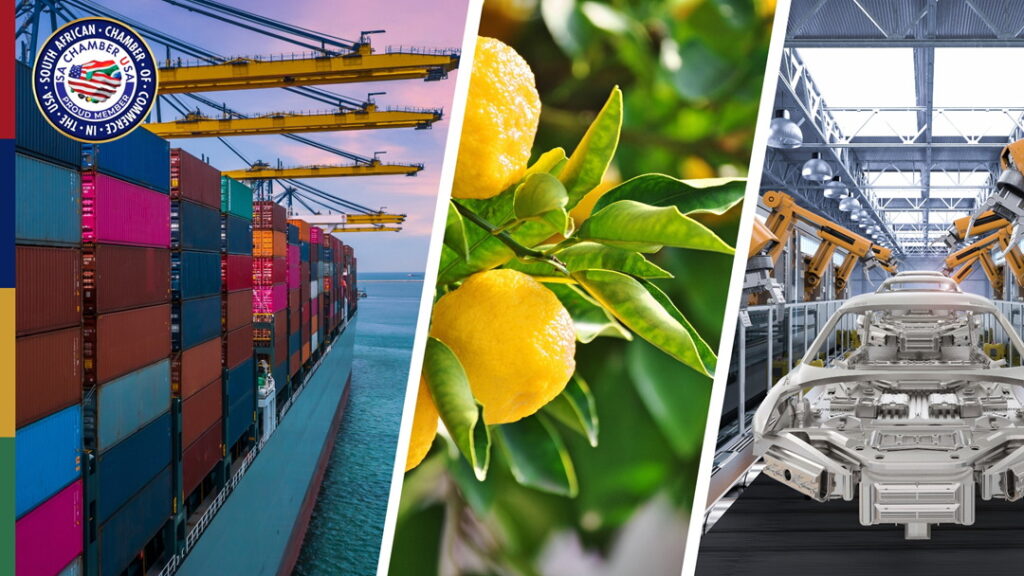
Only part of South Africa’s exports to the US — roughly a fifth — enter under AGOA preferences. But the program matters greatly to automotive manufacturing, agriculture and specialized industrial production. Exclusion would add to the strain on businesses already adjusting to changes in US tariff policy, with knock-on effects for competitiveness, supply chains, investment and employment.
The impact would be felt in the United States too, by American importers, manufacturers and distributors that rely on established South African suppliers.
“This relationship is too important to put at unnecessary risk. It is not only about protecting South African exports. It is about preserving commercial ties that took decades to build, and making sure American businesses continue to see South Africa as a dependable, competitive partner.”
– Neil Diamond
Speaking to Washington’s priorities
SACCUSA believes South Africa must approach Washington in practical, commercial terms, recognizing the current administration’s focus on reciprocal trade, growing American exports, domestic manufacturing, secure supply chains and investment.
Diamond cautioned that South Africa cannot rely on its long history in AGOA, or assume preferences will continue, without addressing the administration’s concerns.
“We cannot simply ask Washington to preserve our trade preferences. We have to show how our partnership creates opportunities for American exporters, investors and businesses — by buying more American goods and services, attracting more US investment and building partnerships that are commercially sustainable for both economies.”
– Neil Diamond
SACCUSA sees clear room to expand US exports to South Africa of agricultural equipment, industrial machinery, technology, energy products and professional services, and for American companies to invest further in South African manufacturing, infrastructure, critical minerals, technology and energy. A stronger reciprocal-trade story would reinforce the economic case for keeping South Africa within the broader US–Africa commercial relationship.
Five actions SACCUSA is calling for
SACCUSA calls on the Presidency, the Department of Trade, Industry and Competition (DTIC) and the Department of International Relations and Cooperation (DIRCO) to coordinate an urgent economic engagement strategy with Washington, prioritizing:
- Get clarity from Washington. Engage the US administration at the highest appropriate level to pin down the specific concerns affecting South Africa’s eligibility and the practical steps that could preserve it.
- Table a credible reciprocal trade proposal. Identify ways to increase US exports to South Africa, reduce commercial barriers and deliver measurable benefits for American businesses and workers.
- Bring in the private sector. Involve South African and American business chambers, manufacturers, exporters, investors and industry bodies in shaping practical commercial solutions.
- Strengthen engagement with Congress and US trade institutions. Use established diplomatic and commercial channels to make the case for bilateral trade and investment to both economies.
- Prepare a business contingency framework now. Help exporters and investors assess tariff exposure, contractual risk and possible supply-chain disruption should South Africa’s eligibility change.
Diamond stressed that these steps must form part of one coordinated national economic strategy, not a series of isolated diplomatic interventions.
“Protecting our access to the American market is an economic priority, not just a diplomatic one. We need clear leadership, coordinated engagement and a commercially credible proposal that shows South Africa is willing to strengthen reciprocal trade with the United States.”
– Neil Diamond
US-based South African business stands ready
SACCUSA believes South African business leaders operating in the United States have an important role to play. Through their commercial networks, partnerships and relationships with American institutions, they can support constructive dialogue and help identify new trade and investment opportunities. The Chamber encourages government to draw on this expertise as it develops its approach to Washington.
“South African business leaders in America understand the US commercial environment and know what it takes to build relationships that deliver real benefits for American businesses. We stand ready to support that engagement and to help build a practical strategy that protects and expands the relationship between our countries.”
– Neil Diamond
The time to act is now
SACCUSA believes South Africa still has a window to strengthen its economic relationship with the United States, but it is closing. Uncertainty over market access discourages investment, delays expansion and erodes confidence in established supply chains. At the same time, the long-term relationship offers substantial opportunity for growth, reciprocal trade and investment.
Diamond closed with a direct appeal to the South African government:
“The question is whether Washington will cut us out of AGOA before Christmas. The more important question is whether our government is doing everything it can to prevent that.
The United States remains one of South Africa’s most valuable economic partners. We are calling on government to act urgently, engage Washington constructively and put forward a credible plan to expand reciprocal trade and American investment.
We must prepare for possible exclusion — but preparation cannot become acceptance. There is too much at stake for businesses, investors and workers in both countries to let this moment pass.”
– Neil Diamond, President, SACCUSA